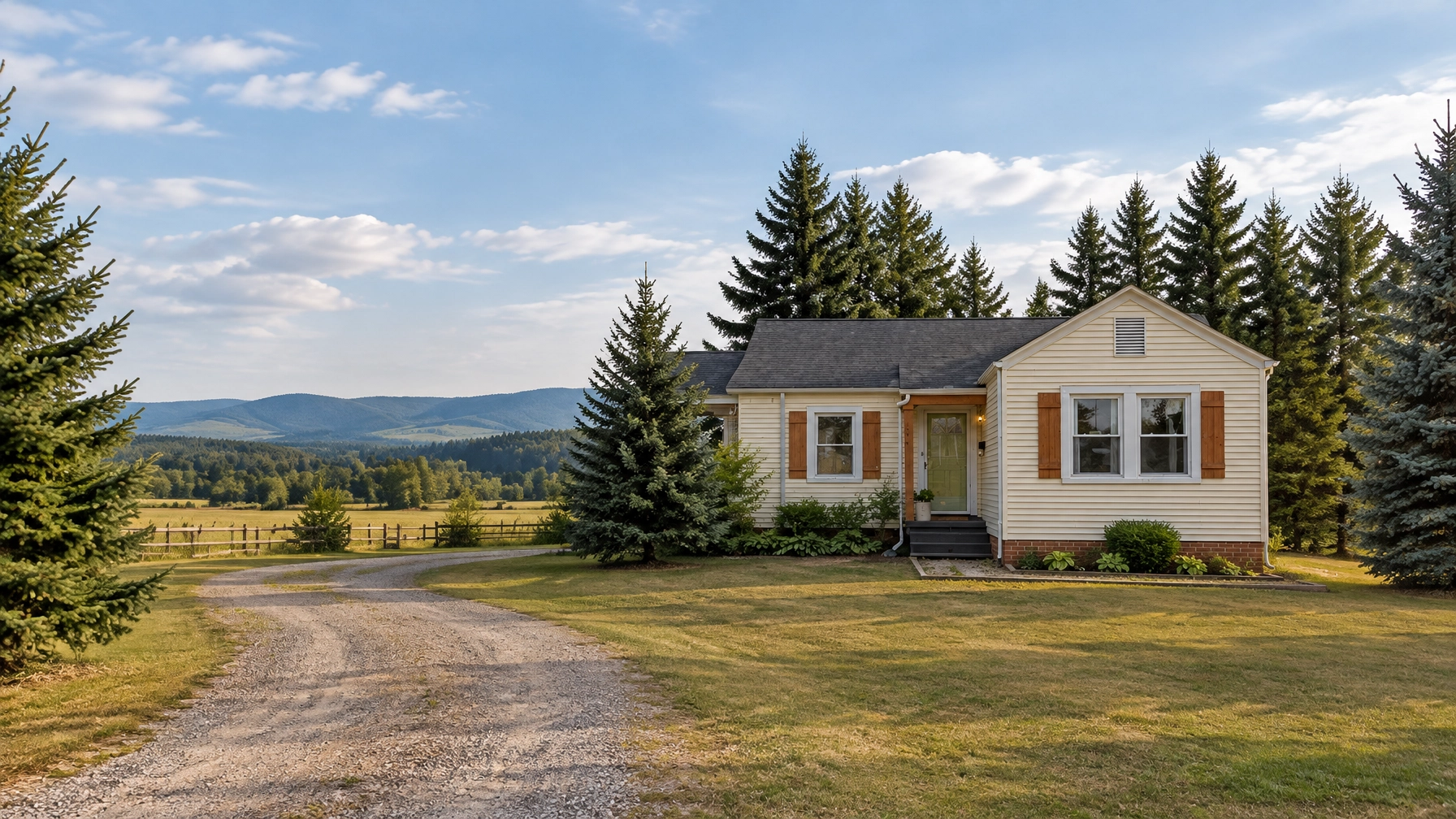
A bank decline can feel especially frustrating in Rocky Mountain House.
You may own a home, acreage, farm, or ranch property with meaningful equity. You may have worked in the oilfield, forestry, agriculture, or local service economy for years. But if your income is seasonal, contract-based, recently interrupted, or difficult to document, a bank’s answer may still be no.
That does not necessarily mean your property cannot support financing.
It may mean your situation needs a different type of lender.
Why Rocky Mountain House homeowners get declined
Rocky Mountain House is a rural service centre of roughly 7,000 people, located about two hours southwest of Edmonton along Highway 11.
The community sits at the gateway to David Thompson Country, Nordegg, and the eastern slopes of the Rockies. Its economy is tied to oilfield services, forestry and sawmills, agriculture, tourism, outfitting, and Clearwater County’s rural industries.
That mix creates opportunity. It also creates income patterns that traditional banks do not always handle well.
A bank may struggle with:
- Oilfield income that rises and falls with the cycle
- Forestry or sawmill work affected by curtailments
- Seasonal employment and contract work
- Self-employed income reduced by legitimate business expenses
- Recent job changes or gaps between contracts
- Farm income that does not fit a standard monthly paycheque
- Long-tenure homeowners with substantial equity but limited verifiable income
There is also the property itself.
Older homes may fall short of a bank’s condition standards. Acreages and ranch properties can raise questions about wells, septic systems, access roads, outbuildings, zoning, and resale demand.
In other words, a Rocky Mountain House mortgage problem is not always a credit problem. Sometimes it is an income-documentation problem, property-type problem, or timing problem.
What is a private mortgage?
A private mortgage is financing secured against real estate and funded by a private lender or investor rather than a traditional bank or credit union.
Private lenders focus primarily on:
- The property’s market value
- The available equity
- The property type and location
- The loan-to-value ratio, or LTV
- A realistic plan to repay or refinance the mortgage
At NOW Mortgage, no credit check is required to get started and see your options. That does not mean credit is irrelevant, but it does mean you can have an initial conversation without being screened out before anyone understands the file.
You can learn more about how this works in our guide to what a private mortgage is.

How much can you borrow against a Rocky Mountain House property?
NOW Mortgage may consider up to 75% LTV, depending on the property type, location, condition, and overall strength of the application.
That does not mean every Rocky Mountain House property qualifies at 75%.
A practical range may look different depending on the collateral:
- Town residential homes: potentially up to 75% LTV where value, condition, and resale are strong
- Older or condition-sensitive homes: potentially lower, depending on required repairs and appraisal results
- Acreages and rural residential properties: often lower than town properties because of resale and servicing considerations
- Farms and raw agricultural land: commonly require significantly more equity; NOW Mortgage’s farm and raw land financing page notes that financing is often structured around approximately 55% LTV, with exceptions considered case by case
This matters in Rocky Mountain House because homes are generally more affordable than in Edmonton or Calgary.
That affordability is good news for buyers. For an equity-based mortgage, however, it can create a practical issue: a modest property value means a modest dollar amount of available equity.
If the mortgage amount is too small, lender fees, legal costs, appraisal charges, and interest can make a second mortgage pointless. A responsible lender should tell you when the numbers do not make sense: not simply approve every possible loan.
Common reasons locals use private financing
Debt consolidation
High-interest credit cards, tax arrears, vehicle loans, and other debts can become unmanageable when oilfield or forestry income drops.
A private mortgage may allow you to consolidate several payments into one secured loan. The goal should be to create breathing room and a clear plan to refinance into lower-cost financing later.
This is similar to what people searching for a debt consolidation mortgage Edmonton may need, even though the property is in Clearwater County.
Divorce or separation buyouts
A separation can create a tight deadline.
One spouse may need to buy out the other, remove a former partner from title, or refinance joint debts while the agreement is being finalized. Traditional lenders may hesitate if income has changed or the legal paperwork is still in progress.
A private mortgage can sometimes provide short-term financing for a mortgage for divorce settlement, allowing one person to keep the home while arranging a longer-term solution.
See our page on divorce and separation financing for examples of situations that may qualify.
Estate and probate settlements
When a homeowner dies, the estate may need funds for taxes, repairs, equalization payments, or other obligations before the property can be sold.
A short-term mortgage against the property may help prevent a rushed sale. This is particularly relevant for older Rocky Mountain House homes, acreages, and family properties that need time to market properly.
Agricultural and ranch financing
Clearwater County includes farms, ranches, acreages, and mixed-use rural properties.
Private agricultural financing Alberta borrowers may use equity for:
- Equipment purchases or repairs
- Operating expenses
- Land improvements
- Bridge financing between sales
- Consolidating existing secured and unsecured debt
- Completing a transaction while conventional financing is unavailable
Agricultural deals require careful review. The lender may consider land use, buildings, access, water, septic, income, and the property’s realistic resale value: not just the number of acres.
Reverse mortgages for local seniors
Many long-time Rocky Mountain House homeowners have paid off, or nearly paid off, homes but do not have enough verifiable retirement income to qualify for a conventional refinance.
A reverse mortgage or other equity-based solution may provide funds without requiring the same type of monthly income qualification.
Possible uses include:
- Supplementing retirement income
- Paying off expensive debt
- Funding home repairs
- Helping family members
- Covering health or accessibility expenses
- Staying in the home longer
A reverse mortgage is not free money. Interest increases the balance over time, and property taxes, insurance, maintenance, and occupancy requirements still apply. Our guide to reverse mortgages and common retiree concerns explains the trade-offs.

Bank versus private lender: a realistic timeline
A bank may offer the lowest long-term pricing, but its process can be difficult when your file is outside standard guidelines.
| Stage | Traditional bank or credit union | Private lender |
|---|---|---|
| Initial review | Several days to two weeks | Often same day or within a few business days |
| Income review | Detailed employment, tax, and debt verification | More flexible; equity and property carry greater weight |
| Property review | Appraisal and condition requirements | Appraisal and collateral review, often with flexible structuring |
| Approval | May require multiple conditions | Often faster once the property and exit plan are clear |
| Funding | Commonly one to three weeks or longer | Potentially within days after approval, appraisal, and legal work |
| Best fit | Stable income and long-term borrowing | Short-term bridge, complex income, urgent timing, or strong equity |
Timelines are not guaranteed. Rural properties can require additional appraisal work, title review, or documentation around wells, septic systems, outbuildings, and land use.
What does private financing cost?
Private mortgages generally have higher rates and fees than bank mortgages.
You may see costs related to:
- Interest
- Lender fees
- Broker fees
- Appraisal
- Legal work
- Discharge or renewal
- Possible extension costs if the exit takes longer than expected
At NOW Mortgage, the focus is on providing a complete upfront cost estimate, including all fees, before you commit.
The key question is not only, “What is the interest rate?”
It is also:
- How much will the mortgage cost in total?
- What will the monthly payment be?
- What is the exit strategy?
- Can you refinance after income stabilizes?
- Is selling the property a better option?
- Is the loan amount large enough to justify the fees?
A private mortgage should normally be a short-term bridge, not a permanent replacement for conventional financing.
How to start without making the situation worse
Before applying, gather:
- Current mortgage statement
- Property tax information
- Recent income or contract documents
- Details of other debts
- Divorce, estate, or settlement documents, if applicable
- Information about wells, septic, shops, barns, and other outbuildings
- A realistic estimate of the property’s current value
You can begin with NOW Mortgage’s financing estimator. It is designed to help estimate potential access to financing without a credit check or obligation.
Rocky Mountain House private mortgage FAQ
Can I qualify with bad credit?
Possibly. Private lenders are generally more focused on property equity and the repayment plan than a bank is. A credit history with missed payments, collections, or a past bankruptcy does not automatically end the conversation.
Can you finance an acreage near Rocky Mountain House?
Potentially, depending on the property, value, location, condition, services, and available equity. Acreages are reviewed differently from standard town homes.
Can I get financing if my oilfield or forestry income is seasonal?
Possibly. Contract and seasonal income may be considered more flexibly, particularly where the property has sufficient equity and the income cycle is understandable.
Is private lending only for people with bad credit?
No. Some borrowers have good credit but need speed, flexible documentation, or financing for a property a bank does not like.
Can I borrow up to 75% on farmland?
Not usually as a standard assumption. Agricultural land and raw land often require more equity than a residential home. The property and application determine the final LTV.
Is a private mortgage better than selling?
Sometimes it can protect your equity and give you time. Sometimes the loan is too expensive or too small to make sense. A proper cost comparison should include selling costs, interest, legal fees, and the likely exit date.
Do you serve Rocky Mountain House, Caroline, and Nordegg?
NOW Mortgage works with Alberta borrowers and reviews files based on the property and circumstances. Rural locations can have different lending limits, so the best first step is a confidential review.
The practical takeaway
When a Rocky Mountain House bank decline is based on variable income, an older home, rural property features, or a life event, it may be possible to structure a private mortgage around the equity you already have.
But private financing is not a magic shortcut.
It costs more than bank financing, it usually has a shorter term, and it needs a clear exit strategy. The right lender should explain the full cost, the realistic LTV, and when the numbers do not work.
If you are considering a private mortgage in Alberta, a home equity loan Alberta solution, or financing connected to a farm, separation, estate, or retirement, contact NOW Mortgage for a straightforward conversation.
No pressure. No credit check required to get started. Just a clear look at your options.

Leave a Reply